Groundwater Modelling
Sustainable groundwater management is essential to protect water resources, support long-term development, and ensure regulatory compliance.
HGEC delivers defensible, regulator-ready groundwater models from early feasibility through detailed design, environmental approvals, operational management and closure. Our modelling practice is grounded in rigorous hydrogeological conceptualisation, disciplined calibration, and transparent uncertainty analysis — ensuring that decisions are supported by evidence, not assumptions.
We specialise in the development of fit-for-purpose numerical models using MODFLOW-6, MODFLOW-USG and integrated surface water–groundwater platforms. Each model is underpinned by a clearly articulated conceptual hydrogeological model (CHM), supported by stratigraphic interpretation, hydraulic parameterisation, recharge estimation, and boundary condition justification.
Conceptualisation First
We place significant emphasis on developing a robust conceptual hydrogeological model prior to numerical implementation. This includes:
- Stratigraphic and structural interpretation (including faults, paleochannels, heterogeneity).
- Aquifer connectivity assessment (vertical leakage, aquitard integrity, perched systems).
- Recharge and discharge mechanisms (diffuse rainfall recharge, focused recharge, river interaction, evapotranspiration).
- Groundwater–surface water connectivity assessment.
- Hydrochemical and salinity trend interpretation where relevant.
Clear conceptualisation reduces over-parameterisation and improves predictive reliability.
Numerical Implementation
Our models are constructed using appropriate spatial and temporal discretisation aligned with the decision context. We routinely undertake:
- Steady-state and transient simulations.
- Layered and unstructured grid development.
- Representation of complex features such as tunnels, declines, dewatering systems, drains, rivers and evapotranspiration.
- ZoneBudget and particle tracking analysis (MODPATH) for capture zone assessment.
- Water balance reconciliation at local and regional scales.
Boundary conditions are justified and sensitivity-tested. Parameter zonation is supported by field testing (slug tests, packer tests, pumping tests) and geological interpretation rather than arbitrary calibration.
Calibration and Verification
Calibration is undertaken systematically against:
- Groundwater level hydrographs.
- Long-term regional trends.
- Stream stage and baseflow observations.
- Pumping responses and drawdown recovery data.
- Salinity and hydrochemical trends where relevant.
We report objective calibration metrics (e.g., RMSE, residual bias, water balance error) and avoid “black box” calibration practices. Where appropriate, we undertake automated parameter estimation using PEST to ensure reproducibility and transparency.
Uncertainty and Risk
HGEC places strong emphasis on predictive uncertainty. Rather than presenting single deterministic outcomes, we evaluate:
- Parameter sensitivity.
- Recharge variability.
- Boundary condition uncertainty.
- Alternative conceptual models.
- Climate variability and long-term residual rainfall trends.
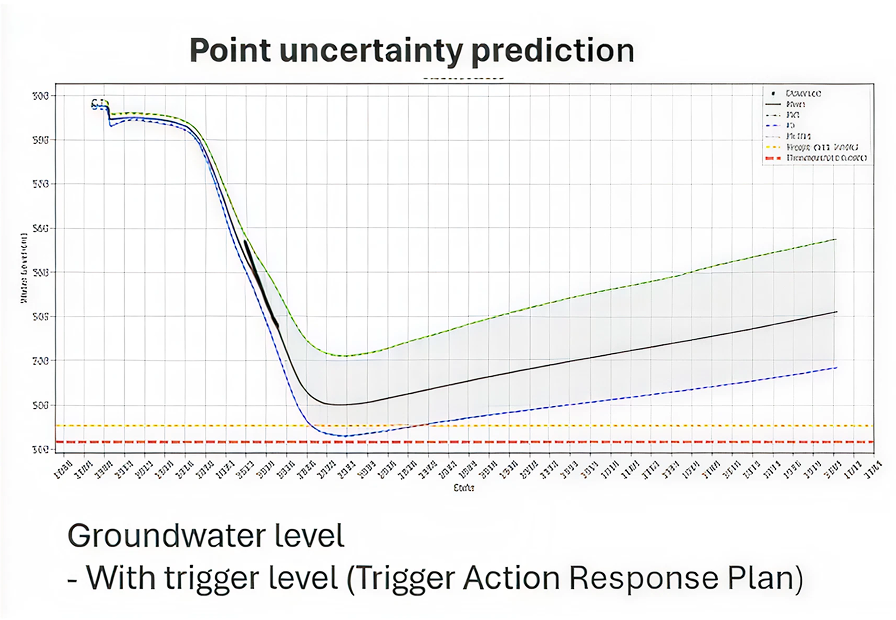
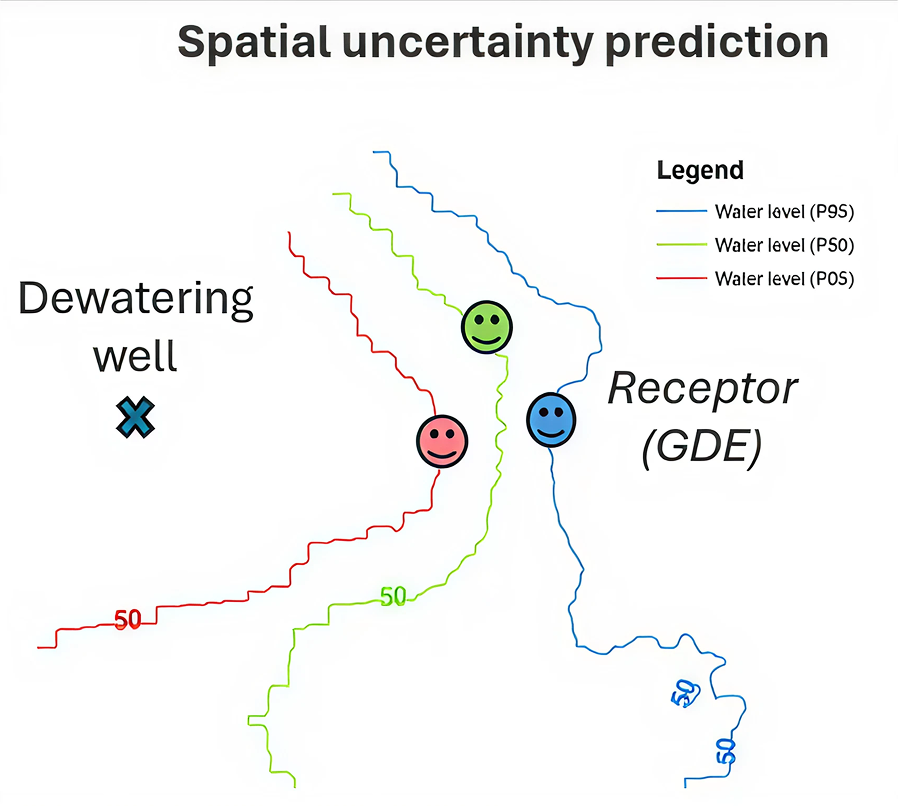
We routinely present P5–P50–P95 predictive envelopes to support risk-informed decision making, particularly for dewatering yield, drawdown extent, groundwater dependent ecosystems, and infrastructure impacts.
Deliverables
We provide regulator-ready documentation including:
- Conceptual hydrogeological model figures and cross sections.
- Calibration plots and statistical summaries.
- Water balance tables and ZoneBudget outputs.
- Predictive scenario comparisons.
- Clear statement of assumptions, limitations and residual risk.
All modelling outputs are designed to withstand peer review and regulatory scrutiny.
Typical Applications
Our groundwater modelling experience includes:
- Open pit and underground mine dewatering assessments.
- Managed aquifer recharge and water supply yield assessments.
- Groundwater–surfacewater interaction analysis.
- Regional cumulative impact assessments.
Modelling Guidelines
- Core engines and problem types: MODFLOW 6 and MODFLOW-USG for complex layering and irregular grids; extensions to MT3D-USGS/SEAWAT for transport and density effects; analytical-element/superposition methods (AEM) for screening and data-sparse studies.
- Calibration workflow: PEST/PEST++ with zonal and pilot-point parameterisation, fitted to multi-objective targets (heads, fluxes, stream–aquifer exchange, and concentrations) with documented diagnostics and residual statistics.
- Ensemble uncertainty: PEST-ENSI and PEST-EIS to capture nonlinearity, explore alternative conceptualisations, quantify prediction credibility, and assess parameter identifiability without prohibitive runtimes.
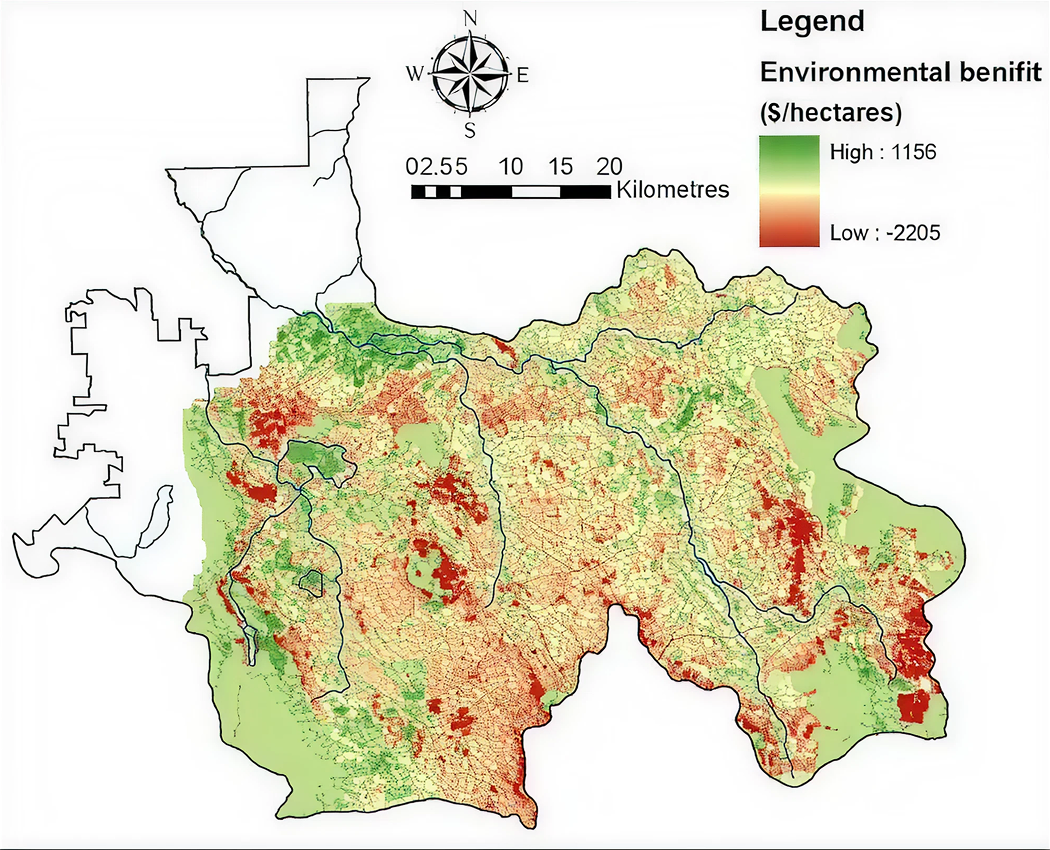
- Use cases and benefits: Dewatering and wellfield optimisation, MAR assessments, groundwater-surface water interactions, plume fate/containment, and licensing/impact assessments—delivered as reproducible model packages with regulator-ready reporting and audit trails
- Forcing and properties: Impulse-response (transfer-function) analysis of long water-level/rainfall records for time-varying recharge and boundaries; hydraulic properties constrained by pumping/recovery and step-drawdown tests, supported by slug and packer testing.
- Decision outputs: Probabilistic forecasts reported as P5/P50/P95 envelopes for excavation inflows, drawdown at receptors, well interference, and salt-load exports, with clear traceability from inputs to predictions.
- Operationalisation (TARPs): P50 informs base operating settings; P95 defines conservative triggers and contingency capacity; P5 identifies optimisation opportunities—directly mapped into Trigger–Action–Response Plans.
Why HGEC?
With more than 30 years of experience in hydrogeology and environmental consulting, HGEC delivers clear, practical, and scientifically defensible groundwater advice. Our independent approach ensures groundwater resources are protected while enabling clients to plan with confidence and certainty.